


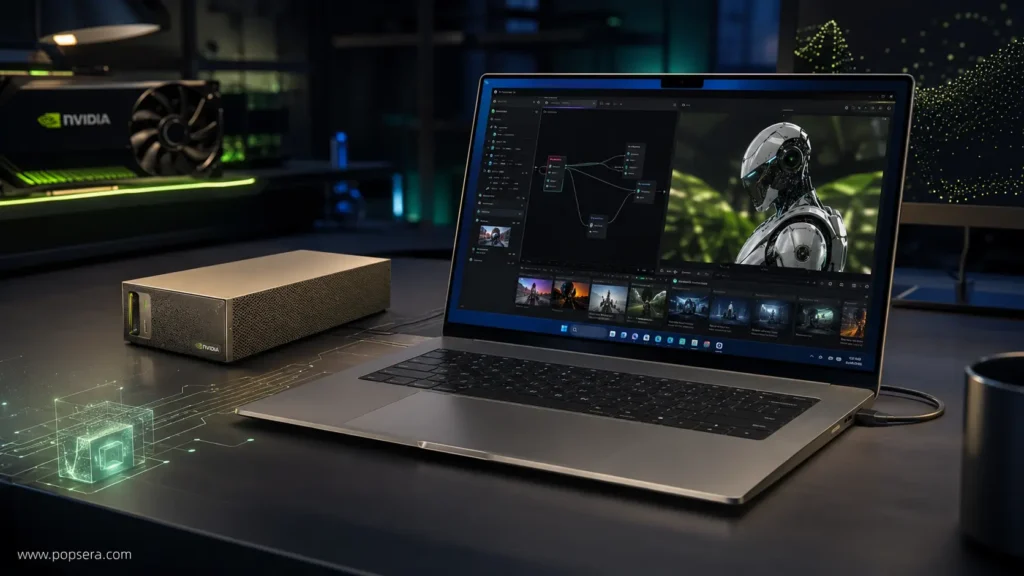

Nvidia RTX Spark is Nvidia’s new AI-focused PC platform, and it lands at a moment when every major chipmaker is trying to define what an “AI PC” should actually do.
The company is positioning the new platform for Windows laptops and compact desktops, combining Arm-based CPU power, Blackwell RTX graphics, unified memory and local AI performance in one package. The pitch is simple but ambitious: instead of sending every serious AI task to the cloud, future PCs should be able to run personal AI agents directly on the machine.
That makes Nvidia RTX Spark more than another graphics announcement. Nvidia is stepping into territory owned for decades by Intel, AMD, Apple and, more recently, Qualcomm: the main processor inside consumer PCs.
Nvidia RTX Spark is built for the AI-agent version of Windows
Nvidia and Microsoft are framing the platform around “personal AI agents,” the next stage of AI software that can do more than answer prompts. The idea is that a PC agent could reason across a project, generate assets, help write code, automate repetitive tasks or move through apps with user permission.
Microsoft said RTX Spark PCs will run with new Windows security and containment features designed to help users control what agents can access and when they act. That detail matters. AI agents sound impressive in demos, but on a personal computer they also raise a basic trust problem: nobody wants software casually clicking through private files, messages or work documents without clear limits.
According to Microsoft’s Windows blog, RTX Spark will support local agentic workloads with up to 128GB of unified memory, while Nvidia OpenShell will work with new Windows primitives for safer agent behavior.
That is the real headline. Nvidia RTX Spark is not just about faster laptop graphics. It is trying to make the PC feel less like a box of apps and more like a local AI workstation.
Nvidia RTX Spark specs target creators, developers and gamers first
The top configuration is not subtle. Nvidia lists up to a 6,144-core Blackwell RTX GPU, a 20-core ultra-efficient CPU, up to 1 petaflop of FP4 AI performance and up to 128GB of unified memory on its RTX Spark product page.
That memory number is especially important for local AI. Large models are hungry, and unified memory gives the CPU and GPU access to the same pool rather than forcing everything through a more traditional split between system RAM and graphics memory.
Nvidia says RTX Spark can handle heavy creative and AI workloads, including ultralarge 3D scenes, 12K video editing and large language models running locally. The company is also bringing over its familiar RTX stack: CUDA, DLSS, Reflex, G-SYNC, TensorRT and OptiX.
For everyday buyers, the first wave probably will not feel like a cheap mainstream laptop. Nvidia RTX Spark is being aimed at creators, AI developers, technical users and high-end gamers before it filters down.
The first Nvidia RTX Spark PCs are expected this fall
Nvidia says RTX Spark laptops and compact desktops are expected this fall from ASUS, Dell, HP, Lenovo, Microsoft Surface and MSI, with Acer and GIGABYTE models to follow. Microsoft is also preparing a Surface Laptop Ultra powered by the new platform.
The device list already makes the announcement harder to dismiss as a concept. RTX Spark is not a single experimental box sitting on Nvidia’s booth floor. It is a platform push with major PC brands attached.
There are still open questions. Final pricing, exact battery life, model-by-model performance and how well legacy Windows apps behave on Arm will matter as much as the keynote claims. Early systems are expected to target the premium end of the market, where Nvidia’s local AI pitch has the best chance of landing first.
That caveat is worth keeping. “AI PC” has already become one of the most overused labels in tech marketing. Nvidia RTX Spark will have to prove it can deliver strong Windows performance, not just impressive AI demos.
Why Nvidia RTX Spark changes the PC race
Nvidia already dominates the AI data center conversation. RTX Spark is about bringing part of that story down to personal devices.
That shift puts pressure on several fronts at once. Intel and AMD have spent years defending the Windows PC processor market. Qualcomm has pushed Arm-based Windows laptops through Snapdragon X chips. Apple reset expectations around efficient laptop performance with its own silicon. Nvidia now wants in, but with a different argument: the future PC should be judged by how well it runs local AI, graphics and agent workflows together.
The timing is not accidental. AI workloads are moving from cloud chatbots into apps people already use: Photoshop, Premiere, code editors, game engines, productivity tools and local model runners. If those workflows become normal, the winning PC chip may not be the one with the best CPU benchmark alone. It may be the one with the best mix of memory, GPU acceleration, battery life, app support and local AI control.
Nvidia RTX Spark still has to prove itself on real laptops
Nvidia RTX Spark sounds like the kind of product that can generate a week of breathless headlines. The more useful way to read it is as Nvidia’s first serious claim on the AI-era PC.
If the hardware performs as advertised, it could make local AI feel less like a developer hobby and more like a built-in part of premium Windows machines. Creators could render, edit and generate without leaning as heavily on cloud services. Developers could run larger models on the same laptop they use to code. Gamers could get high-end RTX features in thinner designs.
But the practical questions are still the ones buyers should watch: price, heat, battery life, app compatibility, repairability and whether AI agents become genuinely useful instead of another feature users turn off.
Nvidia has made the PC race more interesting. Now RTX Spark has to make the PC itself feel different.