



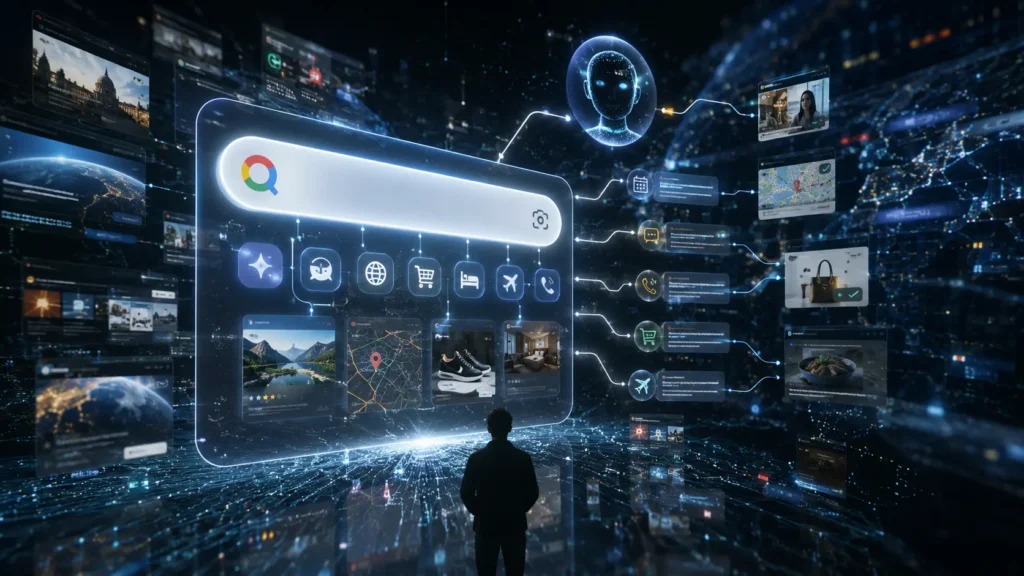

Google Search is moving past the old rhythm of typing a query, scanning blue links, and clicking away.
At Google I/O 2026, the company announced what it calls “a new era for AI Search,” led by an intelligent Search box, AI Mode upgrades, and new Search agents that can monitor the web, synthesize updates, help with bookings, call businesses, and generate custom tools inside Search itself. In plain English: Google wants Search to do more of the work after you ask.
The shift is bigger than another chatbot feature. It changes what Google is for.
The search box is becoming a task box
Google says the new AI-powered Search box is its biggest upgrade to Search in more than 25 years. Instead of being built mainly for short keyword searches, it can expand for longer questions, accept text, images, files, videos, and Chrome tabs, and guide users with AI-powered suggestions rather than classic autocomplete.
According to Google’s official Search announcement, AI Mode has already passed one billion monthly users, with queries more than doubling every quarter since launch. Google is now making Gemini 3.5 Flash the default model in AI Mode globally where AI Mode is available.
That matters because AI Mode is not just a prettier results page. It is Google’s conversational layer for complex, multi-step questions. The company also says users can ask follow-up questions directly from an AI Overview and move into AI Mode while keeping the context of the search.
For users, that makes Search feel less like a directory and more like an assistant sitting on top of the web.
Google’s new Search agents can watch the web for you
The most important part of the announcement is not the redesigned box. It is what happens after the search.
Google says users will be able to create, customize, and manage multiple AI agents inside Search. The first version starts with “information agents,” which can run in the background, monitor the web, and send synthesized updates when something changes.
The examples are deliberately everyday: apartment listings that match a specific set of requirements, sneaker drops from a favorite athlete, or other topics where users currently repeat the same search again and again. Google says these agents will look across blogs, news sites, social posts, and fresh data sources like finance, shopping, and sports.
That is a major change in internet behavior. Instead of searching the web when you remember to, you can ask Google to keep watching it for you.
Search is also getting closer to booking, buying, and calling
Google’s agentic push does not stop at information. The company is expanding booking features in Search to local experiences and services. A user could ask for a private karaoke room for six on a Friday night that serves late food, and Search would pull together pricing, availability, and direct links to finish booking through a provider.
For some categories, including home repair, beauty, and pet care, Google says users will be able to ask Google to call businesses on their behalf. Those features are set to roll out in the U.S. this summer, according to Google.
Shopping is moving the same way. In a separate Google Ads and Commerce update, the company said it is testing Gemini-built ad formats in AI Mode, including Conversational Discovery ads and Highlighted Answers. Google also described AI-powered Shopping ads, Business Agent for Leads, and Direct Offers that can surface inside AI Mode responses.
That is where the internet starts to feel different for businesses. Search is becoming less of a handoff to websites and more of a place where the comparison, persuasion, and transaction can happen before a user ever leaves Google.
Mini-apps inside Search are the wild card
Google also previewed generative UI in Search, which lets AI build custom layouts, charts, simulations, dashboards, and trackers in response to a query. Ask about astrophysics, and Search could generate an interactive visualization. Ask for a fitness tracker, and Search could build a small tool that pulls in live information like reviews, Maps data, weather, and calendar context.
Google describes these as mini-apps users can return to for ongoing tasks, such as planning a wedding, managing a move, or tracking a routine.
This is not traditional search. It is Search becoming a software surface.
The open web problem is getting harder to ignore
Google’s pitch is convenience: fewer tabs, fewer repeated searches, better answers, more action. For users, that is easy to understand.
For publishers, creators, forums, review sites, local businesses, and independent websites, the math is more complicated.
AI answers already reduce the need to click through in some situations. Agentic Search could go further by letting Google monitor, summarize, compare, and act on information from across the web without sending as much traffic back to the original sources. Google still says Search will surface links and supporting articles, but the user journey is clearly becoming more Google-contained.
Recent research is already raising questions about that shift. One 2026 arXiv study on Google AI Overviews found that AI Overviews appeared on 13.7% of trending queries in its sample and rose to 64.7% for question-style queries. Another study comparing traditional Google results, AI Overviews, and Gemini found that AI Overviews appeared for 51.5% of representative real-user queries in its dataset.
Those studies are not the final word on AI Search, but they point to the same pressure: when Google summarizes more of the web, the path between publisher and reader gets shorter, blurrier, and more dependent on Google’s interface.
What changes for regular users
For everyday users, the new version of Search could be useful in obvious ways. A longer, messier question should work better. A repeated search could become an agent. A local booking could take fewer steps. A shopping decision could come with a custom AI explainer.
But the trade-off is also obvious: more of your internet experience happens inside Google’s interpretation of the web.
Personal Intelligence adds another layer. Google says AI Mode can connect to apps like Gmail and Google Photos, with Calendar coming soon, so answers can reflect personal context. The company says users choose when to connect those apps, but the direction is clear. Search is no longer just asking what is online. It is increasingly asking what is online plus what Google knows about you.
Google is not killing search. It is redefining it.
The old Google was a map. The new Google wants to be the driver, the travel agent, the research assistant, the shopping guide, and sometimes the app builder.
That does not mean links vanish overnight. It does mean the web’s center of gravity keeps moving toward AI interfaces that decide what gets summarized, what gets cited, what gets clicked, and what gets handled before a website ever loads.
Google did not just add an AI agent to Search. It made Search itself more agentic.
That is the internet change to watch.






[…] more simple device and tech explainers, Popsera also covers how AI is changing search in Google’s AI agent and internet search breakdown, what to expect from wearable tech in the Oura Ring 5 release date and features guide, and common […]