



Major spoilers ahead for the Euphoria finale, Season 3 Episode 8, “In God We Trust.”
Euphoria did not leave quietly.
After three seasons, a years-long wait, and a final run that pushed the HBO drama far beyond East Highland, the finale ends with Rue Bennett dead, Ali carrying the last emotional weight of the story, and creator Sam Levinson treating the episode as the end of the series. HBO had billed Season 3 as an eight-episode return from Levinson, Zendaya and A24, with the season debuting April 12 on HBO and HBO Max, according to Warner Bros. Discovery’s official press release.
The finale, “In God We Trust,” turns that return into a closing statement. It is not gentle, and it is not built for viewers who wanted Rue to earn a clean, hopeful ending simply because she had suffered enough already.
Does Rue die in the Euphoria finale?
Yes. Rue dies in the Euphoria finale after taking pills that have been laced with fentanyl.
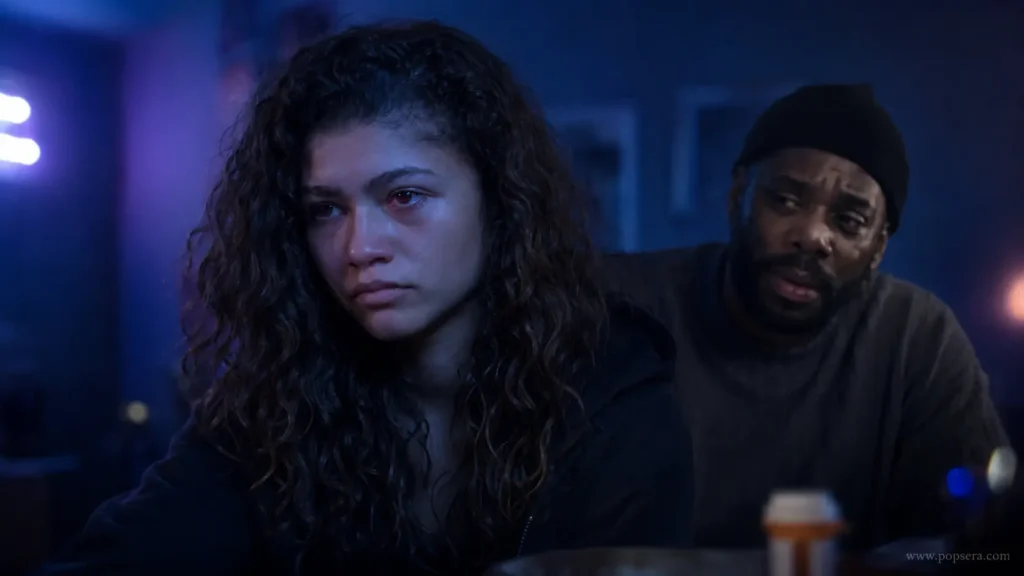
By the end of Season 3, Rue has been trying to survive inside a much darker criminal world than the one the show began with. The final episode reveals that Alamo Brown has learned Rue is secretly working with the DEA. He gives her what she believes are Percocet pills, but they are laced with fentanyl. Rue overdoses and dies on Ali’s couch, cutting off the show’s central voice halfway through the finale.
That timing is the real shock. Euphoria does not save Rue’s death for the final minute. It removes her from the story while there is still a long stretch of episode left, forcing the finale to become less about Rue fighting for another chance and more about what the people around her do with the damage.
Levinson later told Entertainment Weekly that the ending felt like the close of the story the show set out to tell: addiction and its consequences. That framing will not make the ending easier for every viewer. It does explain why the finale refuses the more comforting version of Rue’s arc.
Why Ali becomes the finale’s emotional center
Once Rue is gone, Ali takes over the emotional spine of the episode.
Colman Domingo’s character has always been one of the few adults in Euphoria who could speak to Rue without either romanticizing or condemning her. In the finale, that relationship turns into grief, rage and a final act of violence. After finding Rue dead, Ali goes after Alamo at the Silver Slipper, the strip club that has become the center of the season’s criminal storyline.
The showdown is staged like a neon Western. It is also where the finale’s biggest tonal swing happens: Euphoria moves from intimate addiction drama to revenge tragedy, with Ali killing Alamo after Bishop quietly helps tilt the confrontation against him.
Whether that works depends on what viewers wanted from the ending. As The Guardian noted in its finale review, the episode’s crime-drama turn makes the show feel far removed from the messy teen relationships that first defined it. Still, Ali’s final scenes give the episode its clearest emotional line: he cannot save Rue, so he tries to give her death a shape he can live with.
What happens to Jules, Maddy, Cassie and Lexi?
The finale gives several original characters endings, but not all of them get the same attention.
Jules is left mostly in silence. Her final image is quiet and bruising: she paints Rue, mourning the person who changed her life and then slipped beyond her reach. It is a small ending for a relationship that once felt like the show’s center of gravity.
Maddy and Cassie end the series in a strange, transactional version of freedom. Cassie is living in the aftermath of Nate’s death, while she and Maddy have built a content business out of Cassie’s home. Their friendship has survived in some form, but the finale does not pretend it has healed everything. It is survival, not peace.
Lexi, meanwhile, rejects the offer to join Cassie and Maddy’s operation. She is grieving Rue and carrying guilt, but her ending is one of the few that suggests a person choosing not to be absorbed into someone else’s chaos.
Business Insider’s finale breakdown also notes that Nate, who died in the penultimate episode, remains dead rather than being revived through a late twist, leaving Cassie and Maddy to carry the secret and consequences of that storyline into the final hour.
The Fezco moment gives the finale its softest ache
One of the finale’s most emotional touches is Rue’s dreamlike reunion with Fezco, played by the late Angus Cloud.
Fez does not return in a conventional plot twist. As far as the story makes clear, he remains in prison. Instead, he appears in Rue’s final dreamscape, a memory-like goodbye that lands differently because Cloud died in 2023. People reported that the finale uses never-before-seen footage connected to earlier production, turning the moment into both a character farewell and a tribute to Cloud.
It is one of the few scenes in “In God We Trust” that does not feel engineered to shock. It works because it is simple: Rue sees someone who once made her feel safe.
Is Euphoria really over?
For now, yes. Levinson has described the Season 3 ending as the end of the story, telling Entertainment Weekly that Rue’s death closes the show’s central narrative. When asked whether Euphoria ends with Rue, he answered directly.
That matters because HBO shows can live in a gray zone for years. But creatively, the finale is not written like a cliffhanger. It is written like a door closing, even if some character endings are messy, abrupt or deliberately unresolved.
The final season was already a major reset: the characters were older, the story jumped beyond high school, and the show’s visual language became bigger and stranger. HBO’s own Season 3 logline described the season as a story about faith, redemption and evil. The finale takes that seriously, almost to the point of bluntness.
What the Euphoria finale is trying to say
The cleanest reading is also the hardest one: Euphoria ends by rejecting the idea that pain automatically turns into recovery.
Rue had moments of grace. She had people who loved her. She had flashes of clarity. None of that made her safe from the world the show placed around her, or from the drugs that had defined so much of her life. The finale’s bleakness comes from that refusal to reward the audience with a redemptive arc just because television has trained viewers to expect one.
That choice is going to divide people, and it should. Rue was not just a symbol. She was the show’s heartbeat. Killing her makes the ending feel final, but it also leaves a question hanging over the whole series: did Euphoria deepen its portrait of addiction, or did it trap Rue inside tragedy until there was nowhere else for her to go?
The finale seems convinced those are the same thing.
For viewers affected by the episode’s substance-use themes, SAMHSA’s National Helpline offers free, confidential treatment referral and information support in the U.S. at 1-800-662-HELP (4357).