


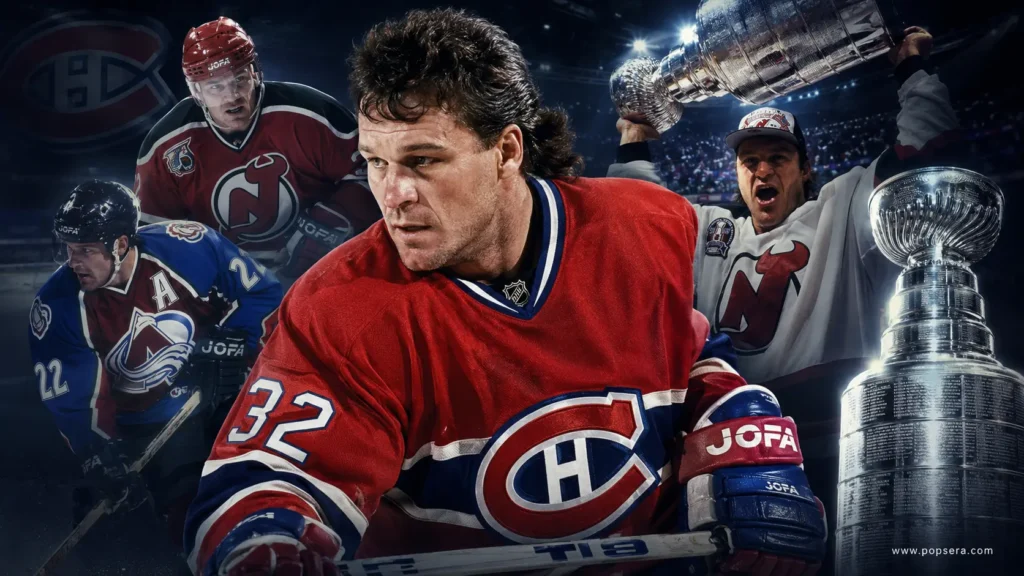

Claude Lemieux’s name never landed softly in hockey. For some fans, he was one of the NHL’s great playoff performers. For others, he was the opponent they loved to hate. Often, he was both in the same shift.
The former Montreal Canadiens, New Jersey Devils and Colorado Avalanche forward has died at 60, with NHL.com reporting Lemieux’s death after the Canadiens announced the news Thursday. The Associated Press later reported, citing authorities, that Lemieux died by suicide.
Popsera is not including additional graphic details. If you or someone you know is in crisis, call or text 988 in the U.S. and Canada for immediate support.
A Stanley Cup résumé that still sparks debate
Lemieux’s regular-season career was long and productive, but his playoff record is the reason his name keeps resurfacing whenever hockey fans argue about big-game players.
He won the Stanley Cup four times: with the Canadiens in 1986, the Devils in 1995, the Avalanche in 1996, and the Devils again in 2000. In 1995, he won the Conn Smythe Trophy as playoff MVP after scoring 13 goals in 20 postseason games for New Jersey, a run the Devils still frame as central to the franchise’s first championship.
That is the cleanest version of the legacy: four rings, one Conn Smythe, and a reputation for becoming more dangerous when the games mattered most.
- Teams: Canadiens, Devils, Avalanche, Coyotes, Stars, Sharks
- Stanley Cups: 1986, 1995, 1996, 2000
- Conn Smythe Trophy: 1995
- Playoff impact: 80 career playoff goals across 234 postseason games
Montreal, New Jersey and Colorado all claim part of the story
Lemieux’s career moved through three of the NHL’s most passionate markets, and each remembers a different version of him.
Montreal remembers the young winger from Buckingham, Quebec, who helped the Canadiens win the 1986 Stanley Cup as a rookie. The Canadiens said he “rose to the occasion in big moments” in their official statement on Lemieux’s death, a fitting line for a player whose career was built on postseason timing.
New Jersey remembers the 1995 run. Lemieux was not just a passenger on that Devils team; he was the chaos engine, the scorer, the agitator and the player opponents could not ignore. The Devils said Lemieux left a lasting legacy and noted his role in bringing the franchise its first Stanley Cup.
Colorado remembers the 1996 championship and, inevitably, the bitter rivalry with Detroit. Lemieux’s hit on Kris Draper during the 1996 Western Conference Final became one of the defining flashpoints of the Avalanche-Red Wings feud, a rivalry that helped shape the NHL’s late-1990s identity.
The edge was impossible to separate from the greatness
Lemieux was not remembered as a neutral star. He played hard, crossed lines, took penalties, drew penalties, scored massive goals and made opponents lose their composure. That combination made him valuable to his own bench and infuriating to everyone else.
That is also why his legacy is more complicated than a trophy count. His best hockey often came wrapped in confrontation. He made playoff series feel personal. He turned routine shifts into grudges.
For casual fans discovering his name now, that tension explains the split reaction: Lemieux was a champion, a villain, a clutch scorer and one of the most effective antagonists hockey has ever produced.
Why Claude Lemieux is being searched now
Search interest around Lemieux spiked after news of his death, but it also came days after he had been back in Montreal for a public playoff moment. NHL.com noted that Lemieux served as the Canadiens’ Bell Centre torchbearer earlier in the week before Game 3 of the Eastern Conference Final against the Carolina Hurricanes.
That timing gave the news an added jolt. Fans had just seen him connected again to the franchise where his NHL story began. Then, almost immediately, hockey was looking back at a career that never fit neatly into one category.
There are easier players to summarize. Lemieux is not one of them.
He was the kind of player whose numbers matter, but whose temperature mattered more. He changed series. He annoyed benches. He scored when the building got tense. And decades later, his name still brings out the old arguments, which may be the most honest sign of how deeply he marked the sport.