


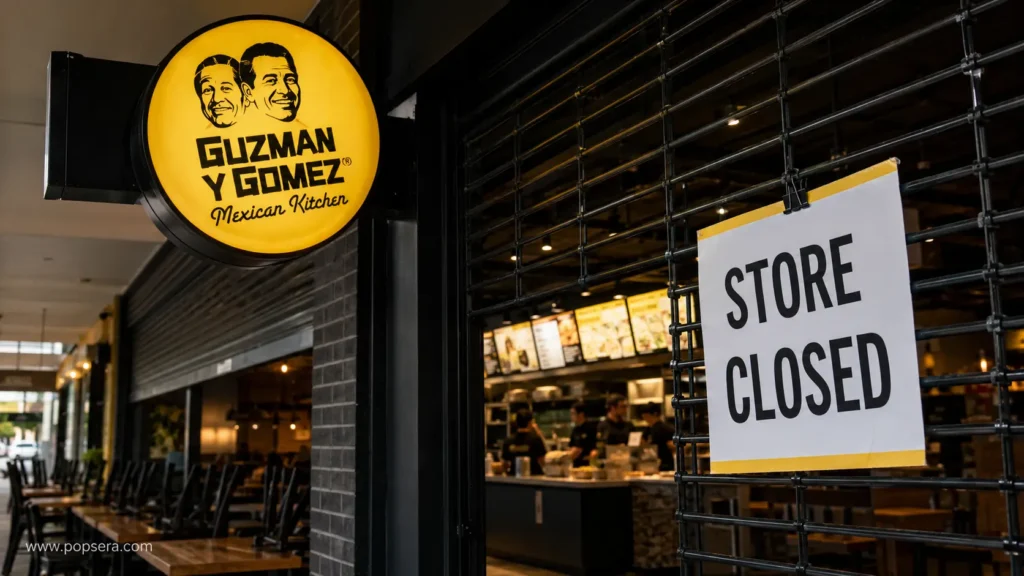

Guzman y Gomez’s U.S. experiment is over. The Australian-born Mexican fast-casual chain has closed its American restaurants and exited the U.S. market, ending a six-year push that started in the Chicago area and was once framed as the beginning of a much bigger expansion.
The move became official on May 22, 2026, when the company said it would stop trading at its Chicago restaurants “with immediate effect,” according to a Guzman y Gomez market-exit statement published by QSR Media. Reuters reported that the company blamed poor U.S. sales and expects a one-off hit of US$30 million to US$40 million from the retreat.
For U.S. customers, the answer is simple: there are no Guzman y Gomez restaurants left to visit in America. For the company, the story is bigger than a few closed burrito shops. It is a sharp pullback from a market it once saw as a major growth prize.
All U.S. restaurants were tied to the Chicago area
Guzman y Gomez did not have a wide U.S. footprint. Its American business was concentrated around Chicago, with locations listed in Illinois markets including Bucktown, Buffalo Grove, Crystal Lake, Deerfield, Des Plaines, Evanston, Naperville and Schaumburg on the chain’s U.S. locations page.
That made the closure feel sudden for local customers, but it also shows why the U.S. exit could happen all at once. This was not a nationwide chain slowly trimming weak stores. It was a concentrated test market that failed to prove it could justify more investment.
The company says sales momentum never caught up
Guzman y Gomez did not blame the food or the team. In its statement, the company said the U.S. operation had made progress on brand building, guest experience and restaurant standards. The problem was the money.
Founder and co-CEO Steven Marks said the U.S. business was not translating that guest experience into stronger sales momentum. The company also said the market would require more time and capital than expected, making continued investment harder to defend.
That is the key detail behind the Guzman y Gomez U.S. closures: the brand may have had a recognizable pitch, but the restaurants did not hit the financial thresholds the board wanted.
A Chipotle-sized market proved harder than it looked
On paper, the U.S. looked like a natural target. Americans already know fast-casual Mexican food. Chipotle built a massive business around burritos, bowls and speed. Guzman y Gomez had a clear brand, a loyal Australian following and a menu that could travel.
But that same logic cuts both ways. The U.S. market is crowded, expensive and deeply competitive. Reuters noted that Guzman y Gomez was trying to break into a country where Chipotle has around 4,000 stores, while the Australian chain was still working from a small Chicago-area base.
The timing also mattered. Restaurant operators in the U.S. have been dealing with higher food, labor and operating costs, while customers have become more careful about spending. A new entrant needs either huge brand heat or a long runway. Guzman y Gomez decided the runway was getting too costly.
The closures have already sparked legal fallout
The story did not end with the locked doors. Former U.S. employees have filed a lawsuit in Illinois, alleging the company failed to give required advance notice before the shutdown, according to Reuters reporting on the Guzman y Gomez worker lawsuit.
The complaint seeks pay and benefits under federal and state WARN Act rules. Reuters reported that Guzman y Gomez said it believes it met its legal obligations, while declining further comment on the case.
That makes the U.S. exit more than a business reset. It is now also a labor dispute, and the outcome could shape how cleanly the company moves on from its American expansion.
Guzman y Gomez is turning back to stronger markets
The company is not shutting down globally. Its U.S. retreat is a refocus. Guzman y Gomez said the decision does not change its belief in the brand’s international potential, pointing instead to Australia, Singapore and Japan as markets with stronger momentum.
That explains why investors initially responded positively. Reuters reported that Guzman y Gomez shares rose as much as 20% after the U.S. exit announcement, as the market weighed the benefit of cutting a money-losing operation against the loss of a major growth story.
For American diners, though, the practical update is blunt: Guzman y Gomez is gone from the U.S. for now. The company built its American dream around Chicago. Six years later, it chose to stop paying for the experiment.