



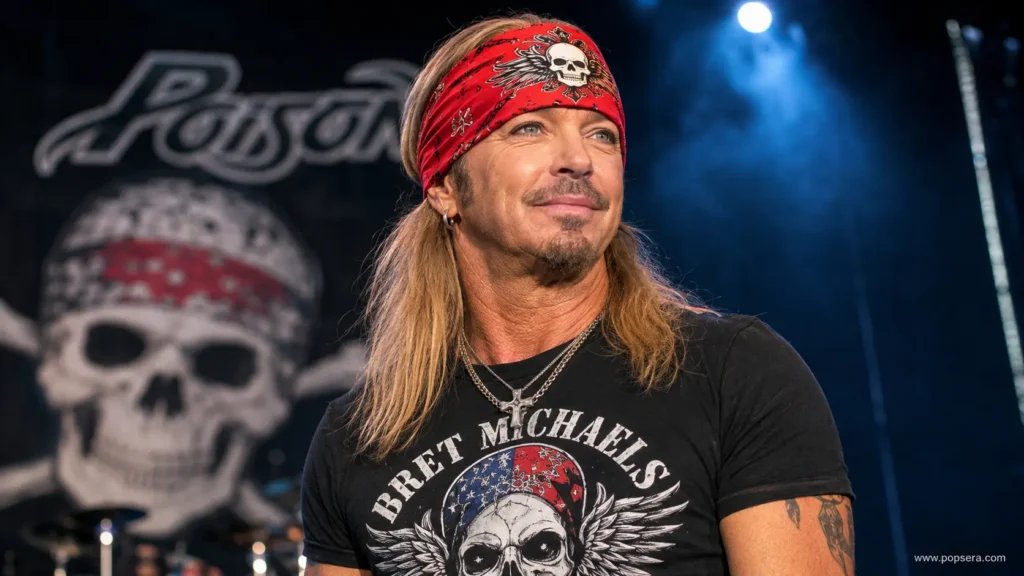

Bret Michaels is back in the headlines for more than one reason. The Poison frontman has stepped away from the Freedom 250 concert event in Washington, D.C., citing safety concerns and saying the show no longer matched the unifying, nonpolitical celebration he believed he had signed on for.
The decision lands at an unusually busy moment for Michaels. He is still touring as a solo act, still fielding questions about Poison’s future, and still attached to one of rock’s most durable nostalgia engines: a band whose biggest songs continue to travel far beyond the hair-metal era that produced them.
The Freedom 250 exit puts Michaels in a larger artist pullout
According to Entertainment Weekly’s report on Bret Michaels leaving Freedom 250, Michaels said the event was first presented to his team as a patriotic music celebration honoring veterans, active military, first responders, teachers, and everyday Americans.
That framing mattered to him. Michaels has frequently tied his public image to military families and first responders, and his own official posts often mention that he is the son of a veteran.
But in his statement, Michaels said the event had become “much more divisive” than what he agreed to join. He also pointed to threats and safety concerns involving his fans, band, crew, family, and himself.
He was not alone. People reported that multiple performers had pulled out of the Great American Freedom 250 concert, including Martina McBride, Young MC, The Commodores, and Morris Day & The Time. Some artists said they had been misled about the event’s political associations, while Freedom 250 organizers maintained that the project is nonpartisan.
Why the event became controversial
The Great American State Fair is connected to the broader America 250 celebration, marking 250 years since the founding of the United States. A White House fact sheet on America’s 250th birthday plans described a National Mall festival planned for 2026 as part of the year-long celebration.
The problem for several performers was not the anniversary itself. It was the way the event was being presented, promoted, and politically framed after they had agreed to appear.
Michaels tried to draw a line around his own decision. His message was not written like a campaign statement. It was written like a performer trying to protect his brand: concerts as escape, not as a flashpoint.
That is a familiar lane for Michaels. Whether he is playing a solo set or leading Poison through “Nothin’ but a Good Time,” the whole business model depends on a crowd that can include people who disagree on everything except the chorus.
Poison reunion questions are still hanging over 2027
The Freedom 250 news also arrived just days after Michaels addressed fresh chatter about a possible Poison reunion. In a May 21 statement on his official website, Michaels said he had become aware of offers for Poison in 2027 and asked for discussions to wait until after Memorial Day weekend.
His message was careful but optimistic. Michaels said he was “forever grateful and excited” about the idea of seeing the other Poison members for a reunion, while also making clear that there are “a lot of moving parts” involved.
Most importantly, he said Poison would not perform under the band name unless all four original members were involved: Michaels, C.C. DeVille, Bobby Dall, and Rikki Rockett.
That matters because the band’s 2026 reunion hopes had already become messy. Earlier this year, Entertainment Weekly reported on Rikki Rockett’s claims about a stalled Poison 40th anniversary tour, with Rockett saying negotiations had broken down over money. Michaels’ May statement did not relitigate that dispute. Instead, it pointed fans toward 2027 as the next possible window.
Bret Michaels is still bigger than one headline
For casual readers, Bret Michaels is still best known as Poison’s bandana-wearing lead singer, the voice behind “Every Rose Has Its Thorn,” “Talk Dirty to Me,” and “Something to Believe In.” His official site notes that “Every Rose Has Its Thorn” hit No. 1 on the Billboard Hot 100 on December 24, 1988.
For another audience, he is a reality TV fixture from Rock of Love with Bret Michaels and Celebrity Apprentice. For longtime fans, he is also a road warrior whose solo shows keep Poison’s catalog alive even when the full band is not touring.
There is another piece of his public story that has never really gone away: his health advocacy. Michaels has lived with type 1 diabetes since childhood, and his Know. Survive. Thrive. diabetes awareness page says he was diagnosed at age six and has used his platform to support diabetes awareness and research.
That mix explains why a Bret Michaels update can travel across several lanes at once: classic rock, reality TV nostalgia, celebrity news, health advocacy, and now a politically sensitive concert controversy.
What happens next
Michaels’ immediate calendar is not empty. His official tour page remains the best place for updated solo dates, while the Poison question is still more wait-and-see than confirmed comeback.
The safest read is simple: Bret Michaels is out of Freedom 250, still active on the road, and leaving the door open for a Poison reunion only if the original lineup can make the details work.
For fans, that last part is the real hook. The controversy may be why his name is moving today, but the reunion question is what will keep people checking back.


[…] Bret Michaels Exits Freedom 250 as Poison Reunion Talk Builds […]